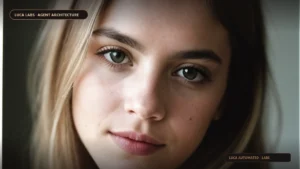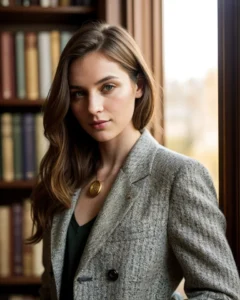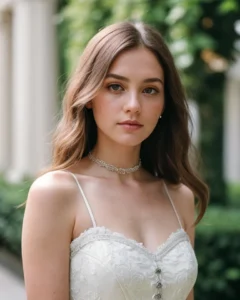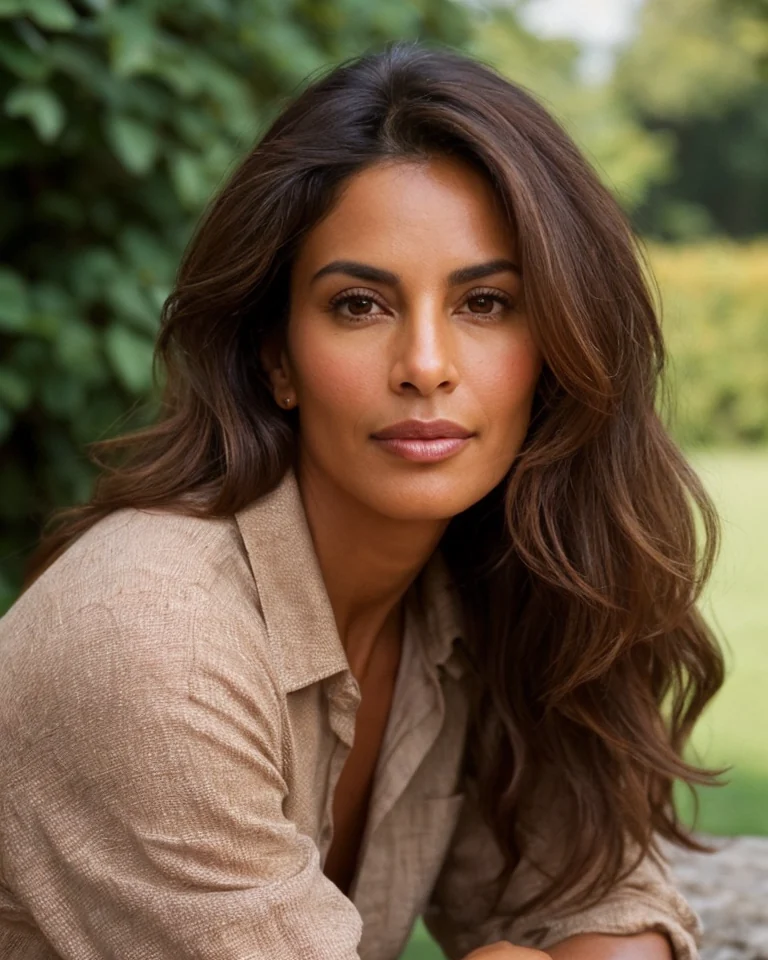
Left to its default weights, almost every diffusion model gravitates toward the exact same composition: a centered, eye-level passport headshot staring flatly into the lens. To elevate generative stills into genuine editorial photography, you must direct camera height, lens focal length, and focal-plane geometry BEFORE describing wardrobe or lighting.
“Where you place the tripod changes the psychology of the subject long before the shutter opens.”
Turning Architecture Into Abstract Geometry
True overhead framing transforms floors, staircases, and projector beams into graphic lines of force. In our recent study Florentine Projector Beam, anchoring the prompt with (true 90-degree overhead top-down bird-eye view:1.45) while suppressing eye level, ground level in the negative prompt forces the latent layout into dramatic vertical foreshortening.
Sculptural Presence and Street Kineticism
Lowering the lens just below hip height elongates architectural silhouettes against evening skies—as demonstrated on wet Parisian ironwork in Rain Over Haussmann. Meanwhile, pairing motion panning camera angle with blurred moving background:1.4 with an over-the-shoulder glance—seen in Marrakech Golden Panning—injects authentic 1/30s street-shutter momentum into still frames.
Keeping Both Intimacy and Landscape Razor-Sharp
Standard f/1.4 portrait prompts dissolve the environment into anonymous creamy bokeh. When the setting carries narrative weight—like sweeping sand ripples in Golden Dunes Split-Diopter or coastal terraces in Amalfi Terrace Solitude—invoking (split-diopter dual-focus composition:1.4) preserves foreground skin micro-pores alongside crisp distant horizons. Explore more studies in our Visual Atelier Gallery →
Key Studio Takeaways
Why do diffusion models ignore camera angle prompts?
Because portrait training datasets are overwhelmingly eye-level. Place your camera angle token in the first 35 tokens at weight 1.35–1.45 and explicitly negate competing angles (such as ‘eye level, passport framing’) in the negative prompt.
What does split-diopter mean in AI prompt architecture?
Borrowed from 1970s cinema optics, ‘split-diopter dual-focus composition’ instructs the model to render both a close foreground face and a deep architectural or landscape background in simultaneous sharp focus.
Which film stock token pairs best with architectural angles?
Kodak Portra 400 with un-airbrushed micro-pore texture maintains natural highlight roll-off across high-contrast stone, glass, and sunlit skin.