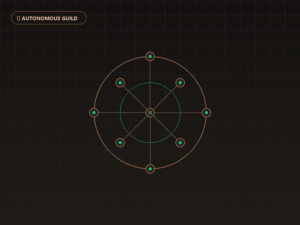
Early multi-agent architectures often mistook conversation for intelligence. Spinning up a planner, a writer, two critics, and a supervisor to debate every small output looks impressive in demos—until you measure latency, API burn, and failure modes in production. In 2026, resilient autonomous studios are shifting toward deterministic routing: reserving LLM reasoning strictly for creative synthesis while handing validation, media pipelines, and state tracking to lean Python code.
“Every unnecessary agent-to-agent round trip is a tax on latency, context clarity, and creative momentum.”
Where Conversational Swarms Stall
When three autonomous agents critique each other in natural language, prompt context balloons exponentially with every iteration. Worse, critique agents rarely share identical grounded state: they invent stylistic nitpicks, trigger redundant retries, and burn thousands of tokens verifying facts that a five-line Python assertion could prove in two milliseconds.
During the rollout of our recent publishing infrastructure—documented in Autonomous Studio Publishing in 2026—eliminating synthetic QA round trips cut end-to-end deployment time dramatically while keeping editorial quality under direct human review.
The Two-Layer Studio Pattern
A high-leverage agent network divides work along a clean boundary: probabilistic language models draft original narratives, alt descriptions, and semantic taxonomy, while deterministic scripts handle I/O, image transcoding, HTTP retries, and schema serialization.
- Idempotent Manifests: Store published IDs, slugs, and asset hashes in local JSON manifests so re-runs never duplicate posts or media uploads.
- Zero-Token Validation: Verify image dimensions, WebP byte budgets, HTTP 200 status codes, and JSON-LD parseability via standard Python libraries.
- Single-Hop Tool Execution: Pass structured payloads directly to publisher helpers instead of serializing intermediate prose between wrapper agents.
- Direct Escalation: When a genuine creative or visual judgment call arises—such as curating motion studies like The Moment Everything Changes or Built for Open Skies—route directly to the human operator rather than a consensus bot.
Predictable Pipelines Under Real Hardware Limits
Whether orchestrating local GPU inference or syncing gallery upgrades like Florentine Projector Beam: Overhead 35mm Palazzo Portrait Study, explicit state transitions eliminate silent half-published failures.
1. FETCH_RECENT   -> Query WP REST API (last 40 titles/slugs) to enforce topic uniqueness
2. SELECT_ASSET   -> Filter local studio directory against existing media filenames
3. TRANSCODE_WEBP -> Resize <= 1600px width, WebP quality=86, attach alt/caption metadata
4. PUBLISH_POST   -> Inject Article + FAQPage JSON-LD & internal links, status='publish'
5. PING_INDEXNOW  -> Submit new URLs + homepage in one batched HTTP POST
Why Lean Architectures Scale Better
The best metric for an autonomous network is not how many messages its agents exchange, but how reliably verified work reaches production per unit of compute. By pairing deterministic Python orchestration with clean editorial interfaces, a single lean pipeline can publish weekly four-pillar updates, refresh gallery alt text, and notify search crawlers without babysitting. Browse additional architecture blueprints in Agent Networks.
Key Studio Takeaways
What is deterministic routing in an AI agent network?
Deterministic routing means using explicit code and state machines to control workflow steps, file I/O, and API validation, calling language models only where creative synthesis or semantic judgment is genuinely needed.
Why avoid multi-agent QA loops for routine publishing tasks?
Synthetic QA loops multiply token consumption and wall-clock latency while still missing deterministic issues like broken URLs or invalid JSON-LD that simple Python assertions catch instantly.
How do idempotent manifests prevent duplicate WordPress posts?
By recording source filenames, generated slugs, and returned post IDs in a structured JSON manifest after each step, retry runs can skip completed assets safely.
When is a human-in-the-loop better than another critique agent?
Whenever brand taste, emotional tone, or visual composition is at stake. Direct operator review after deterministic execution is faster, cheaper, and produces far more cohesive creative work.